
Why Retail Chains Need 24/7 SOC and SIEM Monitoring
Retail looks like a low risk industry from the outside. Friendly staff, loyalty apps, contactless payments. However, from a cybersecurity perspective, retail chains are one of the most attractive targets an attacker can find and one of the most consistently underprepared.
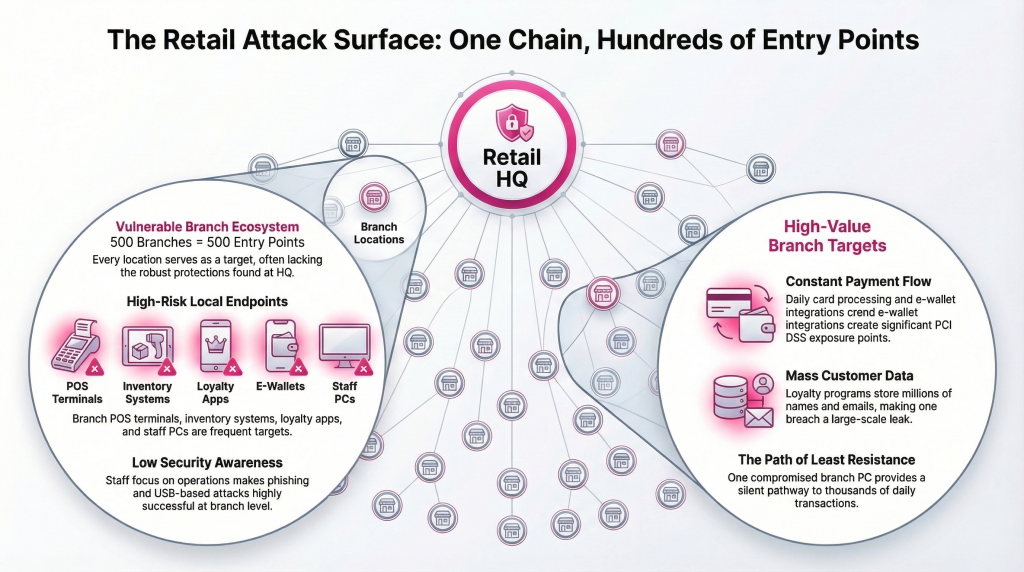
It’s uncomfortable to know: a large retail chain with 500 branches is not one target. In reality, that means 500 entry points. Yet most of them are barely protected.
Why Retail Is a High Value, Low Effort Target
Simply put, attackers go where reward is high and resistance is low, retail offers both.
Mass customer data. Indeed, Loyalty programs and mobile apps store millions of names, emails, and purchase histories. As a result one breach becomes a large scale data leak.
Constant payment flow. After all, POS systems and e-wallet integrations process card data daily. Consequently, every store is a PCI DSS exposure point.
Many branches = many entry points. While HQ may be secure, but branches often run low-cost PCs, low-cost SDWAN and shared passwords.
Low security awareness at store level. Staff are trained for operations, not cyber threats. and as a result, phishing and USB based attacks succeed easily.
Limited monitoring. Most retailers only care about the P&L per store, and lack visibility into cyber protection.
What's Actually Happening in Unmonitored Retail Networks
Even so, without SIEM, all of these threats go completely undetected:
Multiple failed admin logins at a branch server, a brute force attempt in progress, invisible to HQ
Suspicious remote access sessions combined with unexplained inventory adjustments
Malware silently spreading branch to branch through shared network infrastructure
Abnormal transaction patterns, unusual sales volumes, refund spikes, or off-hours activity that signals POS tampering
In most cases, by the time any of this is discovered, it’s usually a customer complaint, a bank alert, or a compliance audit that surfaces it.
What SIEM Makes Visible, In Real Time
Fortunately, a well-deployed SIEM changes the picture entirely. Here’s what it catches that nothing else will:
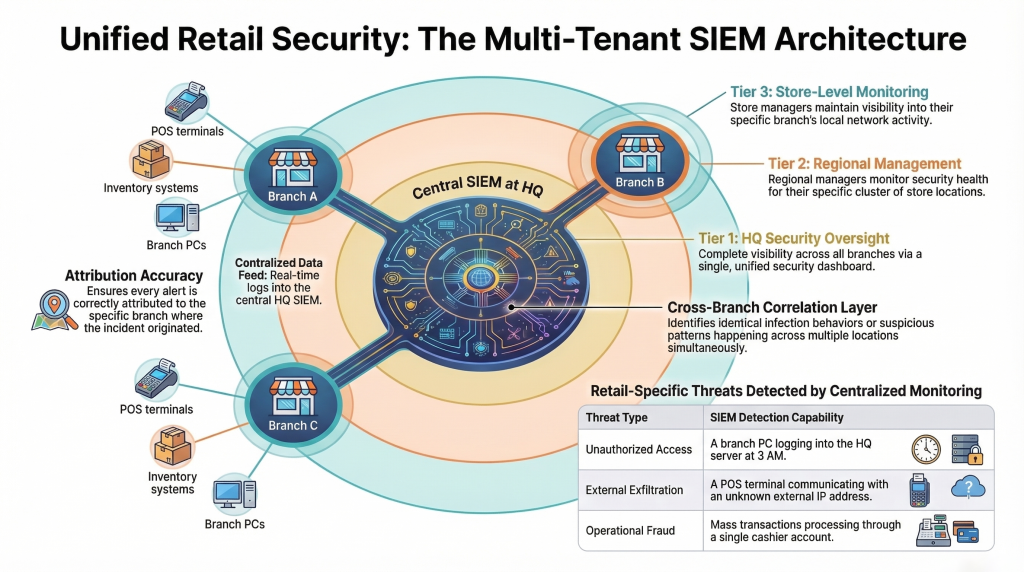
🔴 A store PC logging into the HQ server at 3AM
🔴 POS terminal communicating with an unknown external IP
🔴 Multiple branches showing identical infection behavior simultaneously
🔴 Mass transactions processing through a single cashier account
Notably, these are the exact patterns seen in retail breaches from small chains to global franchises. Crucially, the difference between catching them early and discovering them six months later is a single thing: centralized monitoring.
Multi Tenancy: Monitoring Every Branch From One Place
Here’s a question most retail IT teams haven’t asked: if an alert fires at Branch 47, who sees it?
Without a multi tenant SIEM, the answer is often nobody. Fortunately, a multi tenant architecture solves this by:
Giving HQ a single dashboard across all branches simultaneously
Attributing alerts correctly, you know it’s Branch 47, not just “somewhere on the network”
Tiered access, store managers see their branch, regional managers see their cluster, HQ sees everything
Cross branch correlation, the only way to catch an attack spreading across multiple locations at once
As a result, for any retail chain with more than a handful of locations, multi-tenancy isn’t optional. It’s what makes your monitoring programme actually work.
Compliance Is Not Optional for Retail
Many retail operators assume compliance is someone else’s problem. The bank’s, the payment processor’s, the franchisor’s. In reality, it isn’t.
PCI DSS applies to every retailer that accepts card payments. In practice, non-compliance means fines, potential loss of card processing rights, and full liability for breach costs.
PDPA (Personal Data Protection Act) likewise, covers to any business collecting customer data, which includes every loyalty programme and mobile app.
ISO 27001 is increasingly required by enterprise mall operators, franchise agreements, and corporate insurance policies. In short, it’s no longer just a best practice, it’s a baseline expectation.
Auditors will ask:
Can you show who accessed your POS systems? Are you able to prove your branch network was monitored? Do you have logs from the date of the incident?
Without SIEM, unfortunately, the answer to all three is simply no.
Retail chains are not low risk targets. In fact, they are high reward, low resistance targets, and attackers know it. Every branch is an entry point. Similarly, each POS terminal is easy to enter. Moreover, every loyalty database is a breach waiting to happen.
Ultimately, SIEM monitoring protects your cash flow, your customer trust, and your brand reputation, across every branch, 24/7, from a single dashboard.
Ultimately, the question isn’t whether your retail network will be targeted. Rather it’s whether you’ll see it coming.
Running a retail operation across multiple branches and wondering how exposed you actually are?
We work with retail chains to establish realistic branch-level visibility without disrupting store operations. Specifically, the first conversation is always about understanding your current gaps, not selling a solution.
Let’s talk, and we’ll show you exactly what an attacker would see in your network today.