
How SIEM Powers PCI DSS Compliance in Payment Gateway
In the world of payment gateways, security isn’t just a feature, it’s a legal and operational mandate. To maintain trust and protect revenue, organizations must adhere to the Payment Card Industry Data Security Standard (PCI DSS).
What Is PCI DSS?
Simply put, PCI DSS is a comprehensive security framework required for any organization that stores, transfers, or touches cardholder data. For high-growth tech companies and B2B SaaS providers, achieving Level 1 compliance is often a prerequisite for signing major enterprise contracts or satisfying board-level risk requirements.
PCI DSS covers 12 core security requirements:

The Compliance Clock Never Stops
Here’s what often gets overlooked: PCI DSS is not a one-time project. It’s a continuous obligation with a demanding reporting cadence:
Quarterly – Vulnerability scans
Annually – Penetration testing and policy review
Continuously – Log review and monitoring under Requirement 10
For COOs that handle payment gateways, an audit failure isn’t just a cost, it can mean loss of card brand certification.
For IT Managers, how do you demonstrate compliance when logs are scattered across a dozen systems and the team is already stretched thin?
The answer is SIEM and more importantly, the right SIEM implementation.
Where Most Payment Gateways Fall Short: Requirement 10
In particular, Of all 12 requirements, Requirement 10: Logging and Monitoring is the one that creates the most operational friction. It mandates that:
- Your organization must log and retain every login attempt, privileged action, and configuration change maintaining complete audit logs
- Furthermore, your security team must detect and investigate anomalies
- In addition, the system must trigger alerts for suspicious activity
- Finally, you must have all evidence ready for your QSA during a formal ROC audit
So, what’s the problem? Manual log review at scale is not just inefficient, it’s functionally impossible to do reliably.
How SIEM Solves the PCI DSS Compliance Challenge
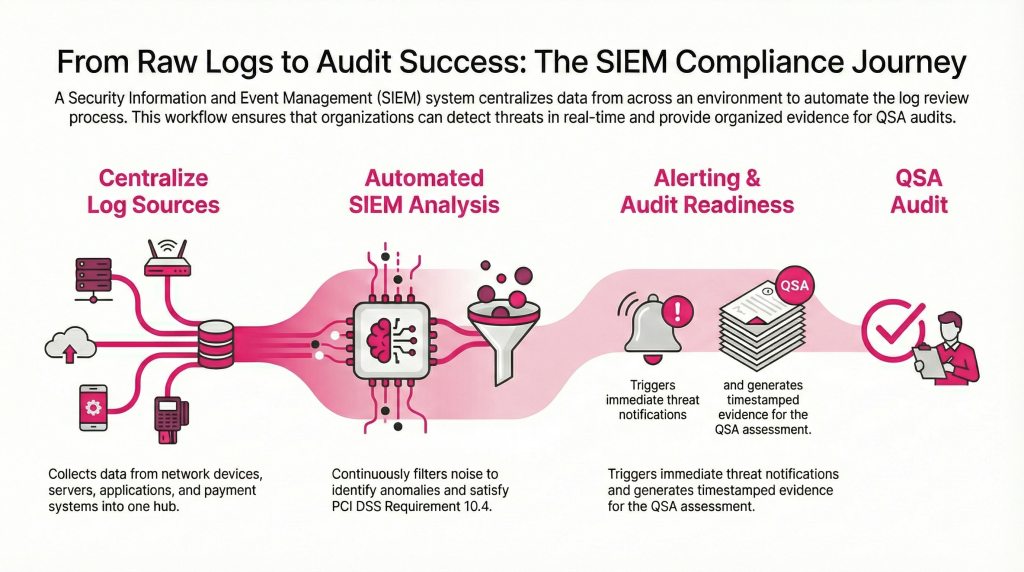
That’s where a Security Information and Event Management (SIEM) system centralizes log data from across your environment, network devices, servers, applications, and payment systems and applies automated analysis in real time.
Specifically, for PCI DSS compliance, a well configured SIEM delivers three critical outcomes:
- Automates Log Review (Requirement 10.4) A SIEM continuously analyzes audit logs, surfaces anomalies, and filters out noise, so your team focuses on real threats, not raw data.
- Generates Audit-Ready Evidence When your QSA arrives for the ROC assessment, your team can pull organized, timestamped logs on demand, no more scrambling to reconstruct a compliance picture under pressure.
- Enables Real-Time Threat Response SIEM driven alerting means brute-force attacks, unauthorized privilege escalations, or anomalous data access patterns trigger immediate notification to your SOC team — before damage is done.
Beyond PCI DSS: The Multi-Framework Reality
However, PCI DSS is rarely the only compliance framework in play. Depending on your business, you may also face:
As a result, managing five compliance frameworks manually creates inconsistency, delays audits, and generates documentation gaps that are expensive to close.
This is precisely where Abatis365 comes in. Abatis365 is a compliance reporting platform that generates structured, audit-ready reports across all five frameworks, PCI DSS, HIPAA, GDPR, NIST, and TCS from a single unified interface.

Ultimately, PCI DSS compliance in the payment gateway industry is non-negotiable. Cardholder data is a high-value target, and the cost of non-compliance, financially and reputationally is severe.
A properly implemented SIEM removes the burden of manual log management, delivers real-time visibility, and produces the audit evidence your QSA will require. Paired with Abatis365, your compliance program becomes proactive, not reactive.
Want to see how Abatis365 simplifies PCI DSS, HIPAA, GDPR, NIST, and TCS reporting? Contact our team or request a demo.
Contact us for inquiries: +6590851964